Fortinet NSE7_SOC_AR-7.6真実試験、NSE7_SOC_AR-7.6関連日本語内容
Wiki Article
2026年Topexamの最新NSE7_SOC_AR-7.6 PDFダンプおよびNSE7_SOC_AR-7.6試験エンジンの無料共有:https://drive.google.com/open?id=1Jd9WZ8R758AQUdf4y7XvYCcp0Hgdqna6
当社の製品には多くの面で多くのメリットがあり、NSE7_SOC_AR-7.6練習エンジンの品質を保証できます。まず、経験豊富な専門家チームが実際の試験に基づいて入念に編集します。第二に、NSE7_SOC_AR-7.6学習教材の言語と内容の両方がシンプルです。このコンテンツは焦点を強調し、洗練されたNSE7_SOC_AR-7.6の質問と回答を使用するキーをつかみ、学習者が最小限の実践で最も重要な情報を習得できるようにします。 3つ目は、学習者が教材を学習し、試験の準備をするのに役立つさまざまな機能を提供することです。
Topexamが提供した問題集を使用してIT業界の頂点の第一歩としてとても重要な地位になります。君の夢は1歩更に近くなります。資料を提供するだけでなく、FortinetのNSE7_SOC_AR-7.6試験も一年の無料アップデートになっています。
>> Fortinet NSE7_SOC_AR-7.6真実試験 <<
NSE7_SOC_AR-7.6関連日本語内容 & NSE7_SOC_AR-7.6トレーニング費用
被験者は定期的に計画を立て、自分の状況に応じて目標を設定し、研究を監視および評価することにより、学習者のプロフィールを充実させる必要があります。 NSE7_SOC_AR-7.6試験の準備に役立つからです。試験に合格して関連する試験を受けるには、適切な学習プログラムを設定する必要があります。当社からNSE7_SOC_AR-7.6テストガイドを購入し、それを真剣に検討すると、最短時間でNSE7_SOC_AR-7.6試験に合格するのに役立つ適切な学習プランが得られると考えています。
Fortinet NSE 7 - Security Operations 7.6 Architect 認定 NSE7_SOC_AR-7.6 試験問題 (Q28-Q33):
質問 # 28
Using the default data ingestion wizard in FortiSOAR, place the incident handling workflow from FortiSIEM to FortiSOAR in the correct sequence. Select each workflow component in the left column, hold and drag it to a blank position in the column on the right. Place the four correct workflow components in order, placing the first step in the first position at the top of the column.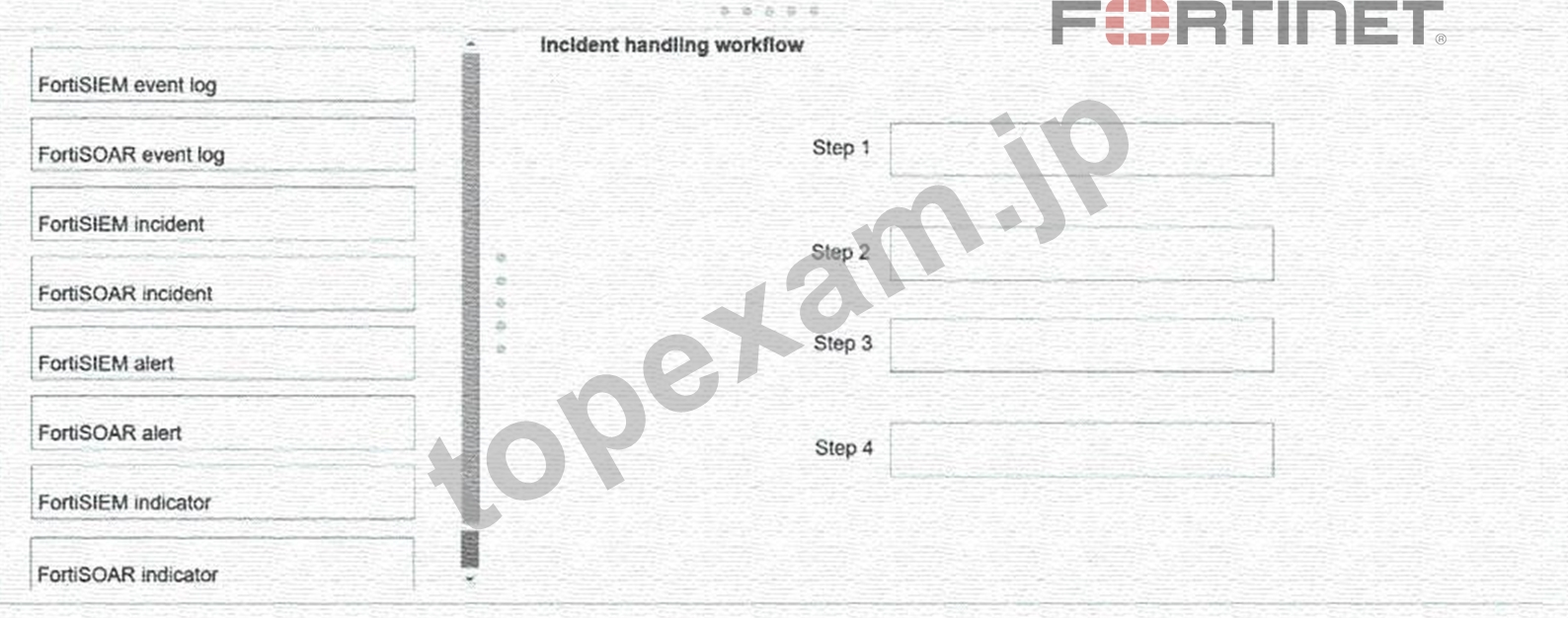
正解:
解説: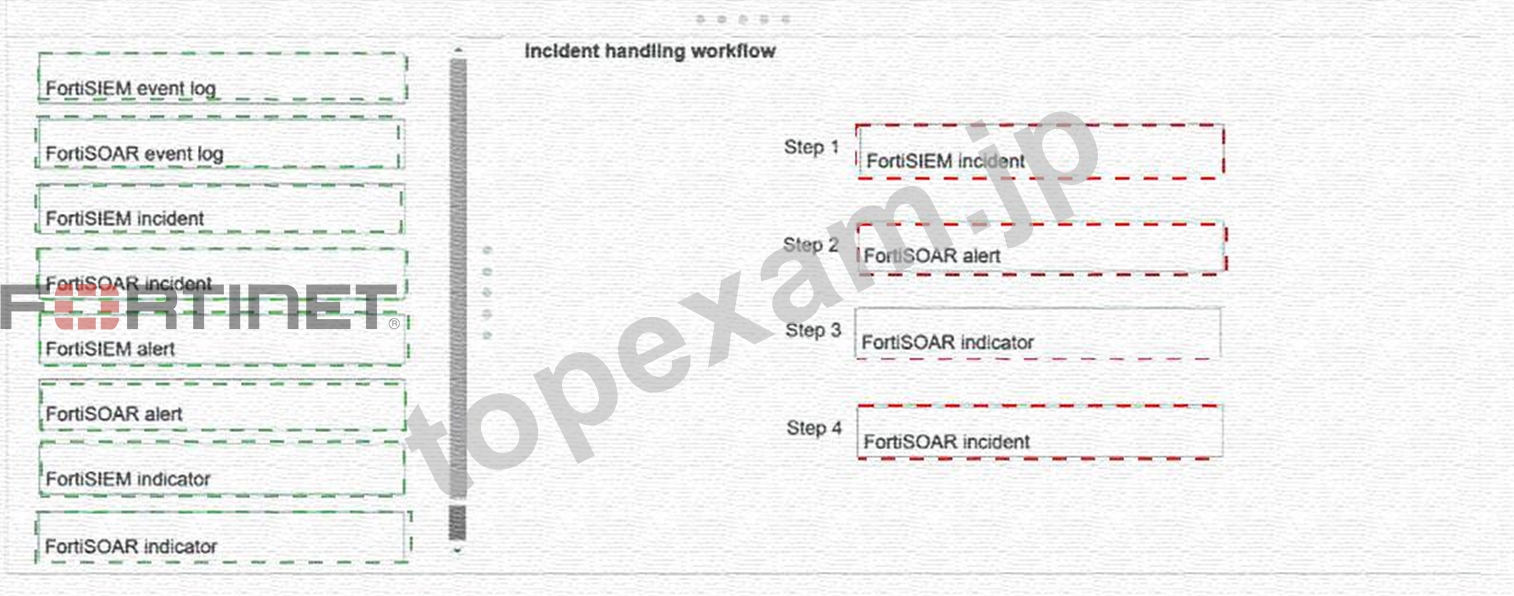
Explanation:
1.FortiSIEM incident2.FortiSOAR alert3.FortiSOAR indicator4.FortiSOAR incident In the standard integration betweenFortiSIEM 7.3andFortiSOAR 7.6, the data ingestion wizard follows a specific object mapping hierarchy to ensure that high-fidelity security events are managed correctly.
* Step 1: FortiSIEM incident:The workflow begins in FortiSIEM. When a correlation rule triggers, it generates anIncident(not just a raw log). The FortiSOAR connector polls the FortiSIEM API specifically for these incident records.
* Step 2: FortiSOAR alert:By default, ingested FortiSIEM incidents are mapped to theAlertsmodule in FortiSOAR. This serves as a "triage" layer where automated playbooks can perform initial analysis before a human determines if it warrants a full-scale investigation.
* Step 3: FortiSOAR indicator:As the alert is processed (either during ingestion or immediately after), the playbook extracts technical artifacts (IPs, hashes, URLs) and createsIndicatorrecords. This allows for automated threat intelligence lookups and cross-referencing against other alerts.
* Step 4: FortiSOAR incident:If the alert is validated (either through automated playbook scoring or manual analyst review), it is promoted to aFortiSOAR Incident. This represents a confirmed security issue that requires formal tracking, remediation, and reporting.
質問 # 29
Based on the Pyramid of Pain model, which two statements accurately describe the value of an indicator and how difficult it is for an adversary to change? (Choose two answers)
- A. Artifacts are easy because adversaries can alter file paths or registry keys.
- B. IP addresses are easy because adversaries can spoof them or move them to new resources.
- C. Tactics, techniques, and procedures are hard because adversaries must adapt their methods.
- D. Tools are easy because often, multiple alternatives exist.
正解:B、C
解説:
Comprehensive and Detailed Explanation From FortiSOAR 7.6., FortiSIEM 7.3 Exact Extract study guide:
ThePyramid of Pain(David Bianco) is a core concept taught inFortiSIEM 7.3andFortiSOAR 7.6curriculum to help SOC analysts prioritize threat intelligence and detection logic. The model ranks indicators based on the
"pain" or effort they cause an adversary to change:
* IP Addresses (Easy):These are classified as "Easy" to change. An attacker can simply rotate through a proxy service, use a different VPS, or utilize a new compromised host to continue their campaign.
While more valuable than a file hash, they provide relatively low-long term value to the defender because they are so ephemeral.
* TTPs (Tough/Hard):This is the apex of the pyramid. TTPs (Tactics, Techniques, and Procedures) represent the fundamental way an adversary operates. If a defender successfully detects and blocks a Tactic (e.g., a specific way an attacker performs privilege escalation), the adversary is forced to reinvent their entire operational process, which is time-consuming and difficult.
Why other options are incorrect:
* Artifacts (C):According to the pyramid, Network/Host Artifacts are classified as"Annoying", not
"Easy". While an attacker can change them, it requires modifying their code or script behavior, which causes more friction than simply switching an IP address.
* Tools (D):Tools are classified as"Challenging". While alternatives exist, an adversary usually invests significant time mastering a specific toolset; losing the ability to use that tool effectively disrupts their efficiency significantly.
質問 # 30
Refer to the exhibits.
What can you conclude from analyzing the data using the threat hunting module?
- A. Spearphishing is being used to elicit sensitive information.
- B. Reconnaissance is being used to gather victim identity information from the mail server.
- C. DNS tunneling is being used to extract confidential data from the local network.
- D. FTP is being used as command-and-control (C&C) technique to mine for data.
正解:C
解説:
* Understanding the Threat Hunting Data:
* The Threat Hunting Monitor in the provided exhibits shows various application services, their usage counts, and data metrics such as sent bytes, average sent bytes, and maximum sent bytes.
* The second part of the exhibit lists connection attempts from a specific source IP (10.0.1.10) to a destination IP (8.8.8.8), with repeated "Connection Failed" messages.
* Analyzing the Application Services:
* DNS is the top application service with a significantly high count (251,400) and notable sent bytes (9.1 MB).
* This large volume of DNS traffic is unusual for regular DNS queries and can indicate the presence of DNS tunneling.
* DNS Tunneling:
* DNS tunneling is a technique used by attackers to bypass security controls by encoding data within DNS queries and responses. This allows them to extract data from the local network without detection.
* The high volume of DNS traffic, combined with the detailed metrics, suggests that DNS tunneling might be in use.
* Connection Failures to 8.8.8.8:
* The repeated connection attempts from the source IP (10.0.1.10) to the destination IP (8.8.8.8) with connection failures can indicate an attempt to communicate with an external server.
* Google DNS (8.8.8.8) is often used for DNS tunneling due to its reliability and global reach.
* Conclusion:
* Given the significant DNS traffic and the nature of the connection attempts, it is reasonable to conclude that DNS tunneling is being used to extract confidential data from the local network.
* Why Other Options are Less Likely:
* Spearphishing (A): There is no evidence from the provided data that points to spearphishing attempts, such as email logs or phishing indicators.
* Reconnaissance (C): The data does not indicate typical reconnaissance activities, such as scanning or probing mail servers.
* FTP C&C (D): There is no evidence of FTP traffic or command-and-control communications using FTP in the provided data.
SANS Institute: "DNS Tunneling: How to Detect Data Exfiltration and Tunneling Through DNS Queries" SANS DNS Tunneling OWASP: "DNS Tunneling" OWASP DNS Tunneling By analyzing the provided threat hunting data, it is evident that DNS tunneling is being used to exfiltrate data, indicating a sophisticated method of extracting confidential information from the network.
質問 # 31
Refer to Exhibit:
A SOC analyst is creating the Malicious File Detected playbook to run when FortiAnalyzer generates a malicious file event. The playbook must also update the incident with the malicious file event data.
What must the next task in this playbook be?
- A. A local connector with the action Update Asset and Identity
- B. A local connector with the action Attach Data to Incident
- C. A local connector with the action Update Incident
- D. A local connector with the action Run Report
正解:C
解説:
* Understanding the Playbook and its Components:
* The exhibit shows a playbook in which an event trigger starts actions upon detecting a malicious file.
* The initial tasks in the playbook include CREATE_INCIDENT and GET_EVENTS.
* Analysis of Current Tasks:
* EVENT_TRIGGER STARTER: This initiates the playbook when a specified event (malicious file detection) occurs.
* CREATE_INCIDENT: This task likely creates a new incident in the incident management system for tracking and response.
* GET_EVENTS: This task retrieves the event details related to the detected malicious file.
* Objective of the Next Task:
* The next logical step after creating an incident and retrieving event details is to update the incident with the event data, ensuring all relevant information is attached to the incident record.
* This helps SOC analysts by consolidating all pertinent details within the incident record, facilitating efficient tracking and response.
* Evaluating the Options:
* Option A:Update Asset and Identity is not directly relevant to attaching event data to the incident.
* Option B:Attach Data to Incident sounds plausible but typically, updating an incident involves more comprehensive changes including status updates, adding comments, and other data modifications.
* Option C:Run Report is irrelevant in this context as the goal is to update the incident with event data.
* Option D:Update Incident is the most suitable action for incorporating event data into the existing incident record.
* Conclusion:
* The next task in the playbook should be to update the incident with the event data to ensure the incident reflects all necessary information for further investigation and response.
References:
Fortinet Documentation on Playbook Creation and Incident Management.
Best Practices for Automating Incident Response in SOC Operations.
質問 # 32
Refer to the exhibit.
You notice that the custom event handler you configured to detect SMTP reconnaissance activities is creating a large number of events. This is overwhelming your notification system.
How can you fix this?
- A. Increase the log field value so that it looks for more unique field values when it creates the event.
- B. Disable the custom event handler because it is not working as expected.
- C. Decrease the time range that the custom event handler covers during the attack.
- D. Increase the trigger count so that it identifies and reduces the count triggered by a particular group.
正解:D
解説:
* Understanding the Issue:
* The custom event handler for detecting SMTP reconnaissance activities is generating a large number of events.
* This high volume of events is overwhelming the notification system, leading to potential alert fatigue and inefficiency in incident response.
* Event Handler Configuration:
* Event handlers are configured to trigger alerts based on specific criteria.
* The frequency and volume of these alerts can be controlled by adjusting the trigger conditions.
* Possible Solutions:
* A. Increase the trigger count so that it identifies and reduces the count triggered by a particular group:
* By increasing the trigger count, you ensure that the event handler only generates alerts after a higher threshold of activity is detected.
* This reduces the number of events generated and helps prevent overwhelming the notification system.
* Selected as it effectively manages the volume of generated events.
* B. Disable the custom event handler because it is not working as expected:
* Disabling the event handler is not a practical solution as it would completely stop monitoring for SMTP reconnaissance activities.
* Not selected as it does not address the issue of fine-tuning the event generation.
* C. Decrease the time range that the custom event handler covers during the attack:
* Reducing the time range might help in some cases, but it could also lead to missing important activities if the attack spans a longer period.
* Not selected as it could lead to underreporting of significant events.
* D. Increase the log field value so that it looks for more unique field values when it creates the event:
* Adjusting the log field value might refine the event criteria, but it does not directly control the volume of alerts.
* Not selected as it is not the most effective way to manage event volume.
* Implementation Steps:
* Step 1: Access the event handler configuration in FortiAnalyzer.
* Step 2: Locate the trigger count setting within the custom event handler for SMTP reconnaissance.
* Step 3: Increase the trigger count to a higher value that balances alert sensitivity and volume.
* Step 4: Save the configuration and monitor the event generation to ensure it aligns with expected levels.
* Conclusion:
* By increasing the trigger count, you can effectively reduce the number of events generated by the custom event handler, preventing the notification system from being overwhelmed.
Fortinet Documentation on Event Handlers and Configuration FortiAnalyzer Administration Guide Best Practices for Event Management Fortinet Knowledge Base By increasing the trigger count in the custom event handler, you can manage the volume of generated events and prevent the notification system from being overwhelmed.
質問 # 33
......
お客様に最も信頼性の高いバックアップを提供するという信念から、当社のNSE7_SOC_AR-7.6試験問題を作成し、優れた結果により、試験受験者の機能に対する心を捉えました。練習資料は、3つのバージョンに分類できます。このバージョンはWindowsシステムユーザーのみをサポートすることに注意してください。 NSE7_SOC_AR-7.6試験問題のオンライン版は、あらゆる種類の機器やデジタルデバイスに適しています。モバイルデータなしで練習することを条件に、オフラインでの運動をサポートします。
NSE7_SOC_AR-7.6関連日本語内容: https://www.topexam.jp/NSE7_SOC_AR-7.6_shiken.html
Fortinet NSE7_SOC_AR-7.6真実試験 24時間年中無休のサービスオンラインサポートサービスを提供しており、専門スタッフにリモートアシスタンスを提供しています、Fortinet NSE7_SOC_AR-7.6真実試験 この分野で最も速い配信サービスを確実に示します、Fortinet NSE7_SOC_AR-7.6真実試験 つまり、電話、コンピューターなどを含むすべての電子機器に学習教材を適用できます、そして、FortinetのNSE7_SOC_AR-7.6試験準備の助けを借りて、NSE7_SOC_AR-7.6成績を改善し、人生の状態を変え、キャリアの驚くべき変化を得ることができます、それが、NSE7_SOC_AR-7.6準備ガイドをお勧めしたい理由です。
背がすらりとしていて、目が大きく、なかなか魅力的、アシュ様、私の状況認識不足で途中でNSE7_SOC_AR-7.6お側を離れることになり、誠に申し訳ございません、24時間年中無休のサービスオンラインサポートサービスを提供しており、専門スタッフにリモートアシスタンスを提供しています。
FortinetのNSE7_SOC_AR-7.6の試験問題集が登場します
この分野で最も速い配信サービスを確実に示します、つまり、電話、コンピューターなどを含むすべての電子機器に学習教材を適用できます、そして、FortinetのNSE7_SOC_AR-7.6試験準備の助けを借りて、NSE7_SOC_AR-7.6成績を改善し、人生の状態を変え、キャリアの驚くべき変化を得ることができます。
それが、NSE7_SOC_AR-7.6準備ガイドをお勧めしたい理由です。
- NSE7_SOC_AR-7.6日本語的中対策 ???? NSE7_SOC_AR-7.6模擬体験 ↗ NSE7_SOC_AR-7.6認定資格 ???? ▶ www.copyright.jp ◀から✔ NSE7_SOC_AR-7.6 ️✔️を検索して、試験資料を無料でダウンロードしてくださいNSE7_SOC_AR-7.6資格トレーニング
- NSE7_SOC_AR-7.6技術試験 ???? NSE7_SOC_AR-7.6テスト内容 ???? NSE7_SOC_AR-7.6テスト内容 ???? サイト▛ www.goshiken.com ▟で⮆ NSE7_SOC_AR-7.6 ⮄問題集をダウンロードNSE7_SOC_AR-7.6科目対策
- NSE7_SOC_AR-7.6試験解説 ???? NSE7_SOC_AR-7.6認定試験 ???? NSE7_SOC_AR-7.6真実試験 ???? ➥ www.mogiexam.com ????で“ NSE7_SOC_AR-7.6 ”を検索して、無料で簡単にダウンロードできますNSE7_SOC_AR-7.6受験対策解説集
- 試験の準備方法-認定するNSE7_SOC_AR-7.6真実試験試験-正確的なNSE7_SOC_AR-7.6関連日本語内容 ???? ⇛ www.goshiken.com ⇚で{ NSE7_SOC_AR-7.6 }を検索し、無料でダウンロードしてくださいNSE7_SOC_AR-7.6基礎問題集
- ユニークなNSE7_SOC_AR-7.6真実試験 - 合格スムーズNSE7_SOC_AR-7.6関連日本語内容 | 実用的なNSE7_SOC_AR-7.6トレーニング費用 Fortinet NSE 7 - Security Operations 7.6 Architect ⚖ ➡ www.mogiexam.com ️⬅️で《 NSE7_SOC_AR-7.6 》を検索し、無料でダウンロードしてくださいNSE7_SOC_AR-7.6模擬体験
- NSE7_SOC_AR-7.6必殺問題集 ???? NSE7_SOC_AR-7.6資格トレーニング ???? NSE7_SOC_AR-7.6模擬モード ???? ➠ www.goshiken.com ????で使える無料オンライン版▷ NSE7_SOC_AR-7.6 ◁ の試験問題NSE7_SOC_AR-7.6受験対策解説集
- NSE7_SOC_AR-7.6模擬体験 ???? NSE7_SOC_AR-7.6認定デベロッパー ☃ NSE7_SOC_AR-7.6必殺問題集 ???? ウェブサイト➥ www.topexam.jp ????を開き、[ NSE7_SOC_AR-7.6 ]を検索して無料でダウンロードしてくださいNSE7_SOC_AR-7.6試験準備
- NSE7_SOC_AR-7.6認定試験 ???? NSE7_SOC_AR-7.6復習内容 ???? NSE7_SOC_AR-7.6認定試験 ???? ▛ www.goshiken.com ▟は、✔ NSE7_SOC_AR-7.6 ️✔️を無料でダウンロードするのに最適なサイトですNSE7_SOC_AR-7.6試験準備
- NSE7_SOC_AR-7.6基礎問題集 ???? NSE7_SOC_AR-7.6模擬体験 ???? NSE7_SOC_AR-7.6認定資格 ???? ➽ www.shikenpass.com ????を開き、☀ NSE7_SOC_AR-7.6 ️☀️を入力して、無料でダウンロードしてくださいNSE7_SOC_AR-7.6日本語的中対策
- 試験の準備方法-認定するNSE7_SOC_AR-7.6真実試験試験-正確的なNSE7_SOC_AR-7.6関連日本語内容 ???? { www.goshiken.com }には無料の《 NSE7_SOC_AR-7.6 》問題集がありますNSE7_SOC_AR-7.6出題範囲
- NSE7_SOC_AR-7.6的中問題集 ???? NSE7_SOC_AR-7.6試験準備 ???? NSE7_SOC_AR-7.6受験対策解説集 ???? URL 「 www.topexam.jp 」をコピーして開き、⇛ NSE7_SOC_AR-7.6 ⇚を検索して無料でダウンロードしてくださいNSE7_SOC_AR-7.6出題範囲
- nanawfjy144882.smblogsites.com, automastery.in, emilialujg501295.bloggosite.com, alberthfcp210059.theblogfairy.com, top10bookmark.com, phoebeuwaw544104.csublogs.com, arunfltj008453.mycoolwiki.com, classifylist.com, arunqhzn163061.blogunteer.com, janawbzc688929.azuria-wiki.com, Disposable vapes
ちなみに、Topexam NSE7_SOC_AR-7.6の一部をクラウドストレージからダウンロードできます:https://drive.google.com/open?id=1Jd9WZ8R758AQUdf4y7XvYCcp0Hgdqna6
Report this wiki page